

MINDSPACE: Understanding Behavioral Control in Modern Governance
A report from a study published by a UK think-tank

“The republican is the only form of government which is not eternally at open or secret war with the rights of mankind.”
Thomas Jefferson, Letter to William Hunter, 1790
Introduction
Modern governance has undergone a fundamental transformation in how it influences citizen behavior. Rather than relying solely on traditional regulatory mechanisms, governments increasingly employ psychological techniques to guide decisions without explicit mandates. This shift represents a move from direct regulation to what behavioral economists term “choice architecture” — the strategic design of decision-making environments.
At the center of this transformation lies MINDSPACE, a framework that has reshaped how policymakers approach behavioral influence. Understanding this system is crucial for anyone seeking to comprehend how contemporary governance operates and its implications for democratic participation.
The Origins and Development of MINDSPACE
MINDSPACE was formally introduced in 2010 through a collaborative effort between the UK’s Institute for Government and what would become the Behavioral Insights Team (BIT). The framework emerged from interdisciplinary research combining psychology, neuroscience, and behavioral economics to create a systematic approach to policy design.
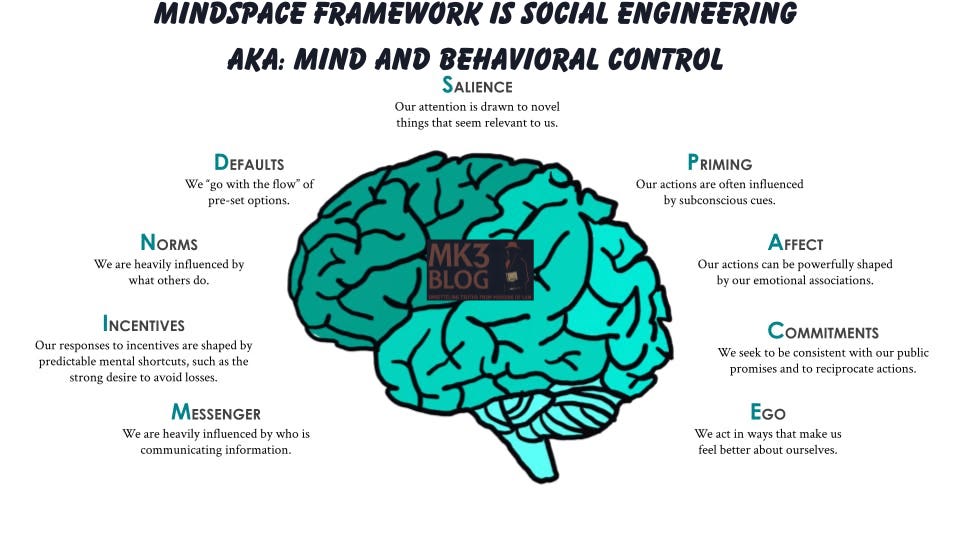
The acronym MINDSPACE represents nine key psychological principles that influence human behavior:
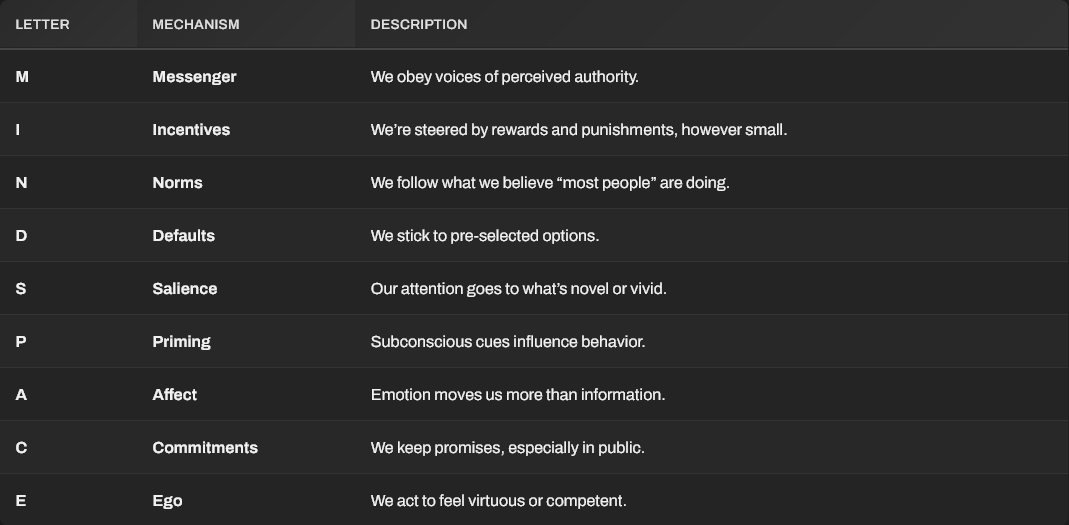
M – Messenger: The source of information significantly impacts how messages are received and acted upon. People respond differently to the same information depending on who delivers it.
I – Incentives: Humans respond to both positive and negative incentives, often in ways that appear disproportionate to the actual stakes involved.
N – Norms: Social behavior is heavily influenced by perceptions of what others are doing, particularly peers and similar demographic groups.
D – Defaults: Pre-selected options have enormous influence over final choices, as most people follow the path of least resistance.
S – Salience: Attention is naturally drawn to information that appears novel, personally relevant, or emotionally significant.
P – Priming: Environmental cues and contextual factors unconsciously influence decision-making processes.
A – Affect: Emotional responses often drive behavior more powerfully than rational analysis or data presentation.
C – Commitments: People tend to act consistently with previous commitments, especially those made publicly.
E – Ego: Behaviors that enhance self-perception or social status are more likely to be adopted and maintained.
The framework was presented as a method for policymakers to work “with the grain of human nature” rather than against it, promising more effective and efficient policy outcomes.
Implementation and Global Adoption
The practical application of MINDSPACE principles marked a significant departure from traditional policymaking approaches. Instead of mandating specific behaviors, governments began redesigning the contexts in which decisions are made. This approach maintains the appearance of individual choice while systematically influencing outcomes.
A prime example is pension auto-enrollment, where saving for retirement becomes the default option. Workers retain the right to opt out, but the psychological and administrative barriers make continued participation the most likely outcome. This technique capitalizes on what behavioral economist Daniel Kahneman describes as System 1 thinking — the fast, automatic, and often unconscious mental processes that guide many daily decisions.
The appeal of this approach for government institutions was substantial. MINDSPACE offered several advantages:
Cost-effectiveness: Behavioral interventions often required minimal financial investment compared to traditional policy tools
Political efficiency: Many nudges could be implemented without legislative processes or public debates
Data generation: Behavioral interventions provided measurable outcomes and rich datasets for policy refinement
Ideological flexibility: The framework was sufficiently neutral to be adopted across different political orientations
By 2015, over twenty countries had established their own behavioral units, with the UK and United States leading implementation efforts. The original Behavioral Insights Team evolved into a commercial consultancy, spreading MINDSPACE principles globally across both public and private sectors.
Practical Applications Across Policy Domains
Public Health
MINDSPACE principles have been extensively applied in public health contexts. Environmental design in institutional settings demonstrates the priming principle: placing healthier food options at eye level in cafeterias while positioning less healthy alternatives in less convenient locations. This approach influences choices without restricting options.
Social norms messaging has proven particularly effective in various health campaigns. Messages emphasizing that “most people in your community” engage in specific health behaviors leverage natural tendencies toward social conformity.
Tax Collection and Compliance
Revenue agencies have successfully employed MINDSPACE techniques to improve compliance rates. Letters including statements like “nine out of ten people in your area pay their taxes on time” have generated millions in additional revenue. These messages exploit the norms principle by suggesting that tax compliance is the standard behavior among peers.
The messenger principle appears in the strategic use of authority figures and trusted institutions to communicate tax obligations, significantly improving response rates compared to standard administrative communications.
Environmental Policy
Climate-related behavioral interventions frequently combine multiple MINDSPACE elements. Energy usage feedback programs use social comparison data (norms), personalized messaging (salience), and appeals to environmental identity (ego) to encourage conservation behaviors.
Default settings for green energy options in utility programs exemplify how choice architecture can advance environmental goals without mandating participation.
Ethical Considerations and Democratic Implications
The implementation of MINDSPACE raises significant questions about transparency, consent, and democratic accountability. Several concerns merit careful consideration:
Transparency and Disclosure
Many behavioral interventions operate without explicit notification to affected individuals. Citizens may not realize they are subjects of psychological influence campaigns, raising questions about informed consent and democratic participation.
Autonomy and Manipulation
The line between helpful guidance and manipulative control becomes blurred when interventions target unconscious decision-making processes. Critics argue that exploiting cognitive biases without explicit consent undermines individual autonomy.
Accountability Mechanisms
Traditional policy tools are subject to legislative oversight and public debate. Behavioral interventions often bypass these accountability mechanisms, implemented through administrative or design decisions that receive little public scrutiny.
Value Imposition
The determination of “better” choices inherently involves value judgments about individual and social welfare. Questions arise about who has the authority to make these determinations and through what democratic processes such authority should be granted.
The COVID-19 Acceleration
The pandemic period demonstrated the full potential and problematic aspects of behavioral governance. Governments worldwide implemented comprehensive behavioral campaigns that incorporated multiple MINDSPACE principles:
Emotional appeals combined with visual salience through dramatic imagery and personal stories
Authority messengers including medical experts and trusted public figures
Social norm messaging emphasizing collective responsibility and community participation
Ego appeals framing compliance as heroic or socially responsible behavior
These campaigns were often coordinated by behavioral science teams with direct connections to the original MINDSPACE framework. The scale and intensity of these interventions provided unprecedented insight into the power and reach of behavioral governance techniques.
Technological Integration and Future Implications
MINDSPACE principles have evolved beyond traditional policy contexts, becoming integrated with digital technologies and algorithmic systems. Modern applications include:
Digital Nudging
Online interfaces increasingly incorporate behavioral design principles, from government websites to mobile applications. These digital nudges can be personalized and dynamically adjusted based on user behavior and demographic characteristics.
Smart City Infrastructure
Urban planning and public infrastructure design increasingly incorporate behavioral principles, influencing how citizens move through and interact with public spaces.
Social Media and Information Environments
The same psychological principles underlying MINDSPACE are now embedded in commercial platforms and information systems, creating complex ecosystems of behavioral influence that extend far beyond government policy.
Toward Responsible Behavioral Governance
Addressing the challenges posed by behavioral governance requires establishing new frameworks for democratic oversight and citizen protection. Several principles should guide future development:
Enhanced Transparency
All behavioral interventions should be subject to public disclosure requirements. Citizens have the right to know when and how their psychological processes are being targeted by policy design.
Democratic Oversight
Behavioral policies should face the same level of scrutiny as traditional legislation. This includes public debate, legislative review, and regular assessment of outcomes and methods.
Opt-Out Protections
Individuals should retain meaningful choices about participation in behavioral interventions, including clear and accessible mechanisms for opting out of specific programs.
Independent Evaluation
Regular audits by independent bodies should assess the effectiveness, ethics, and democratic implications of behavioral governance programs.
Conclusion
MINDSPACE represents a fundamental shift in how governments approach behavioral influence, moving from explicit regulation to subtle environmental design. While this approach offers genuine benefits in terms of effectiveness and efficiency, it also raises profound questions about democratic governance, individual autonomy, and the nature of free choice.
Understanding these systems is essential for maintaining meaningful democratic participation in an era of increasingly sophisticated behavioral influence. The challenge lies not in eliminating behavioral considerations from policy design, but in ensuring that such approaches remain transparent, accountable, and consistent with democratic values.
As behavioral governance techniques become more sophisticated and pervasive, citizens must develop greater awareness of these systems and their implications. The future of democratic governance may well depend on our collective ability to navigate the tension between effective policy design and individual autonomy, ensuring that the tools of behavioral science serve rather than subvert democratic participation.
The conversation about MINDSPACE and behavioral governance is ultimately about power — who exercises it, how it is applied, and through what mechanisms citizens can hold their governments accountable. These questions become more pressing as behavioral techniques evolve and proliferate across both public and private sectors, making informed citizen awareness and robust democratic oversight more critical than ever.